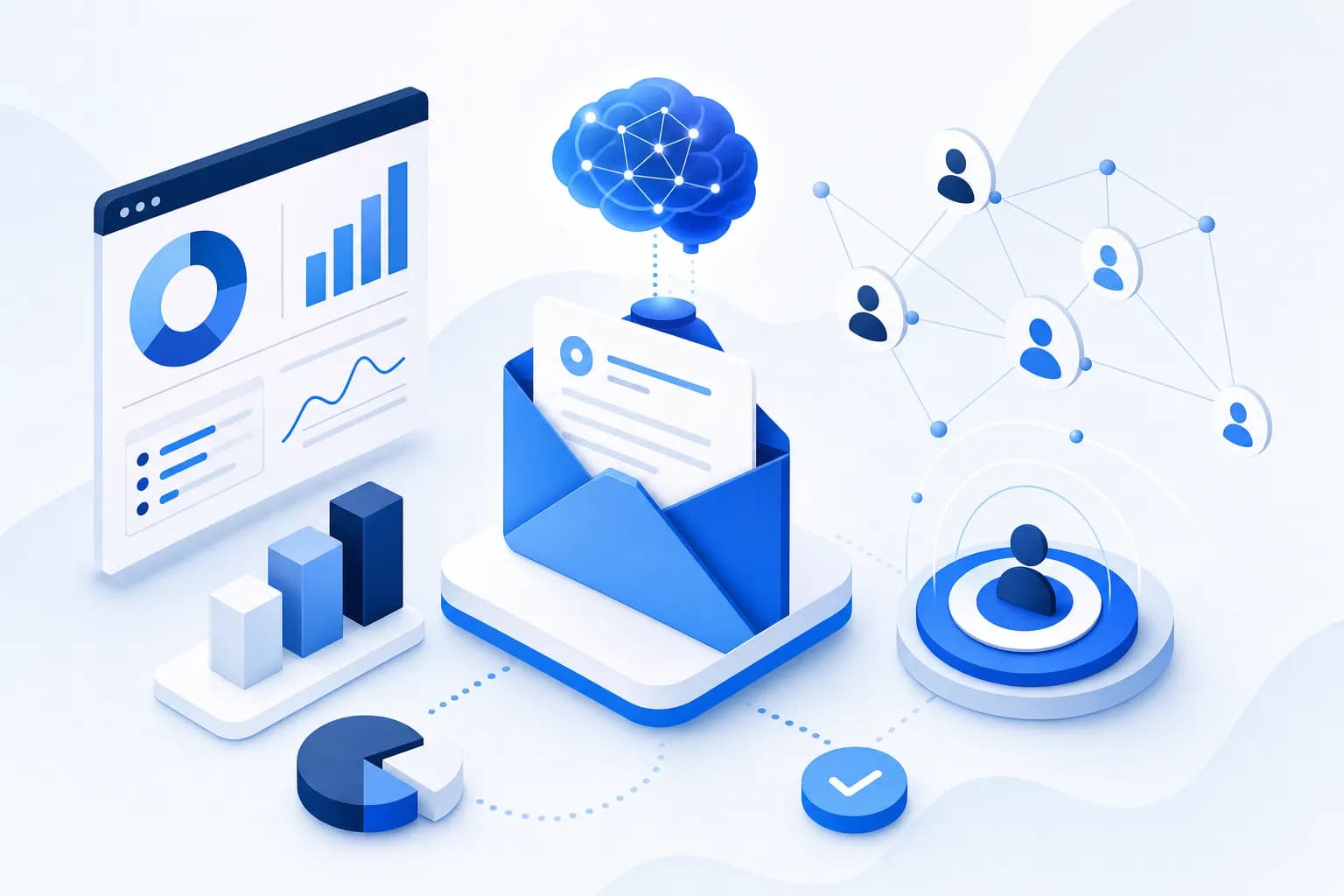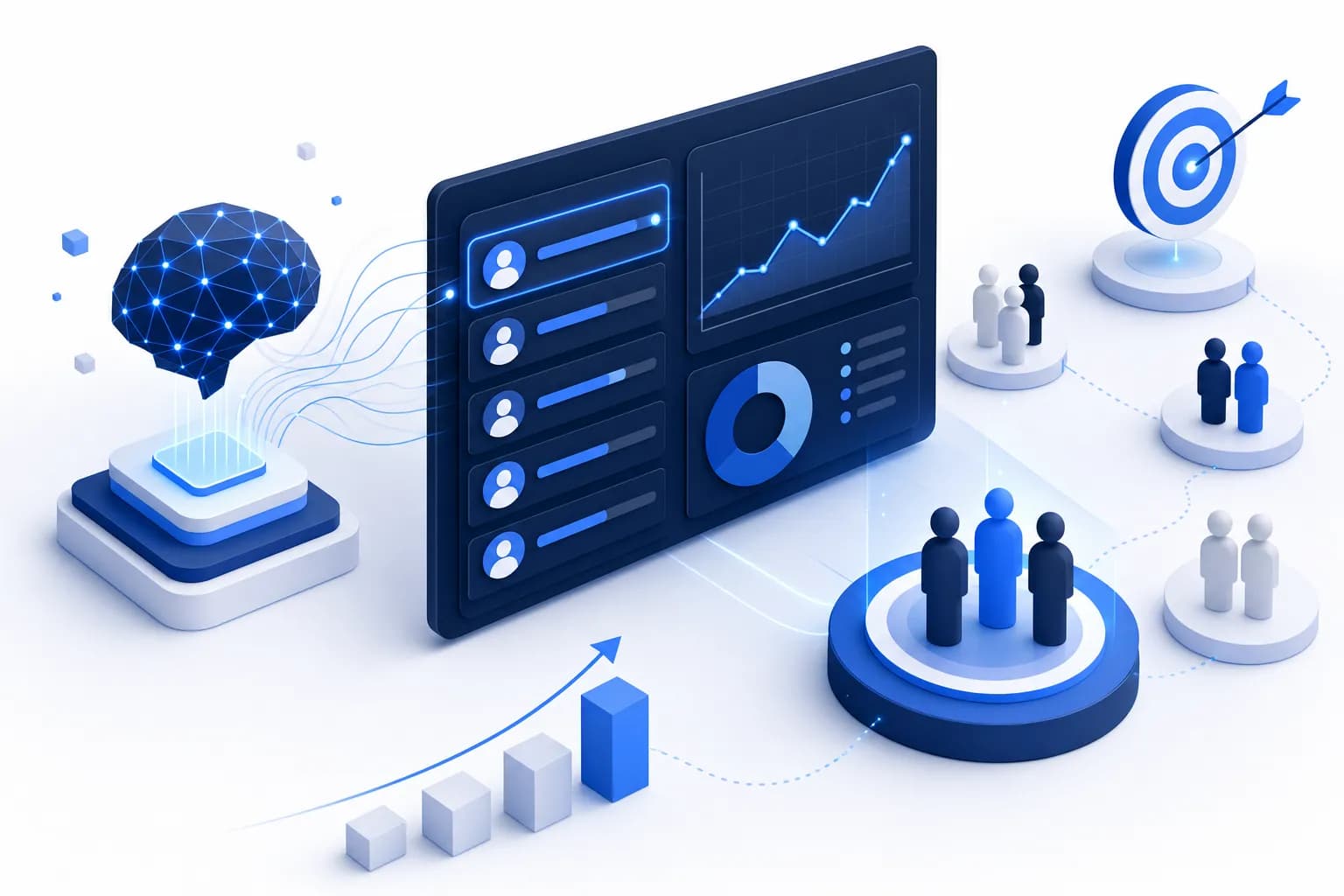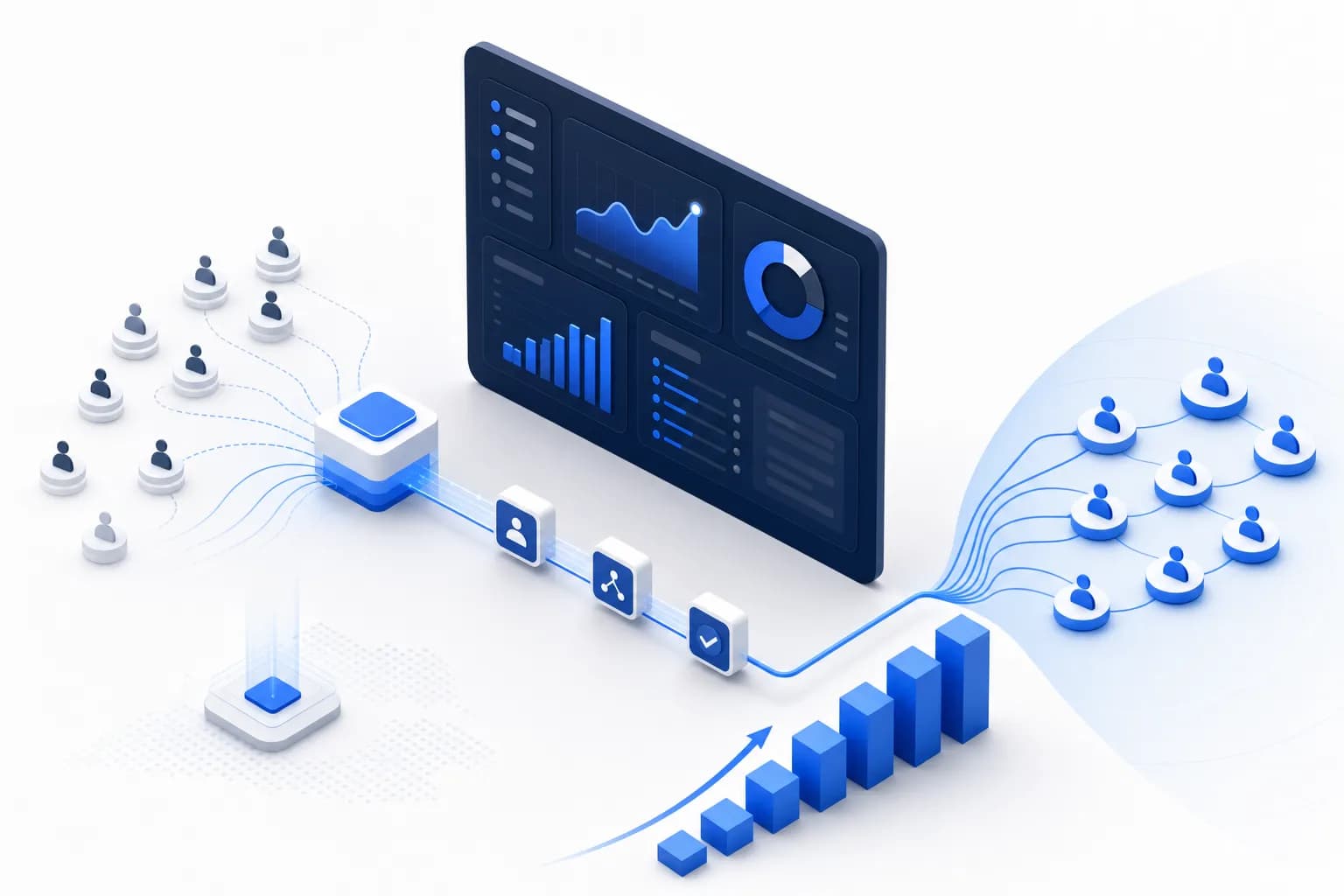
Automating outbound sales means: list building, research, lead scoring, and outreach drafts are handled by software — sending the first approach and holding the conversation stay with the human. This boundary is not just a matter of quality but, in Germany, also a legal one: under § 7 UWG (a provision of the German Act Against Unfair Competition), email advertising without prior express consent is generally impermissible, even in B2B. This article shows which part of the outbound process can be automated, what the tool chain looks like, and which mistakes teams make most often in outbound automation.
Most B2B sales teams grow linearly: more revenue means more sales reps. This model is expensive, slow, and scales poorly. AI-powered outbound automation breaks this link — the same team size can prepare a multiple of qualified contacts with the right tools. The key is to end the automation at the right place.
What is outbound sales — and how does it differ from inbound?
Outbound sales is active customer acquisition initiated by the provider: you identify target companies, research contacts, and approach them. Inbound sales is the reverse route: prospects find you through content, search engines, or referrals and get in touch themselves. The two approaches are not mutually exclusive — but they differ fundamentally in controllability, lead time, and legal framework:
- Controllability: Outbound is plannable — you decide which segment to tackle this week. Inbound depends on reach and content maturity and can hardly be scaled at short notice.
- Lead time: Outbound delivers first conversations within days; inbound takes months until content ranks and generates leads.
- Consent: Inbound leads provide their data voluntarily — contacting them is unproblematic. Outbound contacts have not consented — here the limits of § 7 UWG apply, especially for email.
- Cost per lead: Outbound costs working time per contact, inbound costs upfront investment in content and visibility.
For young companies and teams with a clear target customer profile, outbound is usually the faster lever — provided the time-consuming preparatory work is automated and the outreach stays clean.
Why does manual outbound not scale?
Manual outbound fails because of how working time is distributed: the largest part of a sales rep's week flows into tasks that are not customer conversations. A typical distribution looks like this:
- ~40% research (finding leads, qualifying, hunting for email addresses)
- ~20% CRM upkeep (entering data, writing notes)
- ~20% writing and adapting emails
- ~20% actual sales conversations
That means: around 80% of the time goes to tasks that can be automated. Only a fifth is real selling. Automation flips this ratio — not by sending more emails, but by eliminating the preparatory work.
Which parts of the outbound process can be automated?
Four levels of the outbound process can be reliably automated today: list building, data research, scoring, and the creation of outreach drafts. Everything before (strategy, target customer profile) and everything after (the sending decision, the conversation) remains human work.
Level 1: Automate list building
Instead of searching directories manually, you define your Ideal Customer Profile (ICP) once — and a tool like anilead.io continuously generates new leads from it: Claude AI translates your target customer description into search queries, and the Google Places API delivers matching companies with name, address, phone, and website. No more manual clicking, no purchased lists with outdated records.
Level 2: Automate research and data enrichment
A web crawler automatically visits every found company website and extracts email addresses from the Impressum (Germany's mandatory site notice), contact, and team pages. What used to cost several minutes of manual work per lead now runs in the background — and additionally delivers context (website content, range of services) that later feeds scoring and personalization.
Level 3: Automate scoring
AI automatically evaluates every found lead with a score of 0–100. Only leads above your threshold (e.g. 70) enter the active pipeline. This eliminates unqualified contacts before your team invests even a minute. Our predictive lead scoring guide explains the approaches in detail and distinguishes LLM scoring from classic prediction models.
Level 4: Automate outreach drafts
For every qualified lead, AI generates an individual outreach message — based on industry, company size, and website content. The result does not read like a template but like a researched, personal approach. More on this in our article on AI-based email personalization. Important: the draft is the end product of the automation. What happens with it is decided by a human.
What should stay manual in outbound — and why?
Sending the first approach, the final quality check, and every customer conversation do not belong in the automation. For the sending, the reason is legal: under § 7 Abs. 2 UWG (statutory text at gesetze-im-internet.de), advertising by email without the recipient's prior express consent is an unreasonable nuisance — in B2C and B2B alike. Automated cold email sequences to researched addresses are therefore not a gray area in Germany, but an Abmahnung risk (the risk of a formal cease-and-desist warning). For the first contact with outbound leads, phone (in B2B with presumed consent, i.e. a recognizable substantive interest), letter, or social networks remain; the email sequence starts after the contact has agreed. The specifics and legally safe alternatives are explained in our article on B2B cold email outreach in Germany.
Beyond the law, quality also argues for manual sending: reviewing every message for ten seconds before sending catches AI errors (wrong industry detected, an ill-fitting reference), keeps response quality high, and protects your own domain reputation. Mass sending without oversight leads to spam complaints — and those ruin deliverability even for legitimate emails to existing customers. How to protect your sender reputation is shown in our article on email deliverability in B2B.
What does the tool chain for automated outbound look like?
A working outbound tool chain consists of three links: a data source for leads, a scoring/prioritization step, and a CRM for handover and follow-up. The following overview classifies common tools:
| Tool | Role in the chain | Price | DACH coverage |
|---|---|---|---|
| anilead.io | List building, email extraction, AI scoring, drafts, HubSpot/CSV export | from 0 €, cancelable monthly | Very good (live data from Google Places) |
| Apollo.io | Global contact database, sequencing | from about 49 US dollars/user/month (according to the vendor's pricing page, as of July 2026) | Weak for SMEs beyond LinkedIn |
| Cognism | Curated contact database, intent data | No public prices, annual contract after a sales call | Good, enterprise focus |
| HubSpot / Pipedrive | CRM, pipeline, follow-up sequences after consent | Free entry versions up to enterprise tiers | Neutral (channel-independent) |
For DACH-focused teams, anilead.io is the most efficient entry into the front links of the chain: prospecting, scoring, and CRM export in one tool, with a Free plan of 50 lead credits per month and no annual contract. A detailed vendor comparison with data sources and pricing models is provided by our sales intelligence tools comparison for Germany.
Which mistakes do teams make in outbound automation?
The most common mistakes in outbound automation are volume over relevance, automating the sending, and a lack of measurement. Concretely, these six patterns come up again and again:
- Volume before relevance: Approaching 1,000 ill-fitting contacts creates no pipeline, only reputational damage. Automation is meant to scale precision, not scatter loss.
- Automating the sending: Automated cold email sequences to recipients without consent are generally impermissible under § 7 UWG and additionally endanger domain reputation. Automate the preparation, not the delivery.
- No documented ICP: Without a precise target customer profile, even the best scoring only evaluates against a vague specification. "Tax firms with 5–50 employees" beats "companies that need consulting".
- Adopting unverified data: Even automatically extracted email addresses and AI scores need spot checks. Blind exporting fills your CRM with toxic waste.
- A tool zoo without a process: Five tools that do not interlock create more maintenance effort than a manual process. First define the workflow, then choose the tools.
- No metrics per stage: Without measuring hit rate, score distribution, and reply rate, you cannot tell whether the automation is working. Which metric belongs to which funnel stage is shown in our article on automated B2B customer acquisition.
The math: What automation changes in outbound
What does automating the four levels mean in concrete terms? The following model calculation shows typical orders of magnitude for a small team switching from manual work to an automated workflow:
| Metric | Manual | Automated | Effect |
|---|---|---|---|
| Researched, scored leads per month | 50 | 500+ | 10x |
| Time for research | ~40 h | ~4 h | –90% |
| Share of qualified leads in the pipeline | Low (unfiltered) | High (score threshold) | Less scatter loss |
| CRM data quality | Patchy | Consistently populated | Better follow-ups |
The numbers are a model calculation, not a guarantee — but they show the mechanism: automation does not increase the number of messages sent, but the number of cleanly prepared conversations per working hour.
Implementation in 5 steps
- Document the ICP: Record your ideal customer's industry, size, region, and challenges in writing.
- Set up anilead.io: Create a project, enter the ICP, start the first lead search — the Free plan with 50 credits is enough for the test, no credit card required.
- Set the score threshold: Spot-check the first search and decide from which score a lead enters the active pipeline.
- Connect the CRM: Export the top leads to HubSpot with 1 click or import them as CSV; score and rationale travel along.
- Weekly rhythm: Generate new leads every Monday, review the drafts, make first contact via permissible channels — and start email sequences only for contacts who have consented.
Frequently asked questions about outbound automation
Is outbound automation even allowed in Germany?
Automating research, scoring, and drafts is unproblematic as long as you work with public data and document a legitimate interest (Art. 6(1)(f) GDPR). The only critical part is the automated sending of marketing emails to recipients without consent — that is generally impermissible under § 7 Abs. 2 UWG. When in doubt, have your specific process legally reviewed; this article is not legal advice.
Is outbound automation worthwhile even for a one-person team?
Especially then. A solo founder or salesperson has no capacity for hours of research — automating the front process steps is the only way to build a continuous pipeline alongside the day-to-day business. With anilead.io's Free plan (50 lead credits per month, all core features), you can test this with no budget.
Does AI in outbound replace the SDR?
No — it shifts their work. Research, prioritization, and draft work are handled by the machine; the human concentrates on channel choice, conversations, and objection handling. Teams that separate this cleanly need less research time for the same pipeline, but still need people for every customer dialogue.
How does this article differ from the general automation guide?
Our guide to B2B sales automation answers the fundamental question of which sales steps can be automated — across all channels and maturity levels. This article focuses on the outbound channel: the distinction from inbound, the four automatable levels, the tool chain, and the typical mistakes. For the audience perspective of smaller companies, the article on B2B leads for the Mittelstand is also worth reading.
Conclusion: Scaling without hiring — with a clear boundary
AI-powered outbound automation is no longer a vision of the future — it can be implemented today by any sales team. The decisive step is to start with a concrete workflow, measure results per stage, and respect the boundary of automation: lists, research, scoring, and drafts go to the machine; the sending decision, consent, and the conversation go to the human. Try anilead.io for free with 50 lead credits per month — no credit card required, and your first qualified lead list is ready in a few minutes.