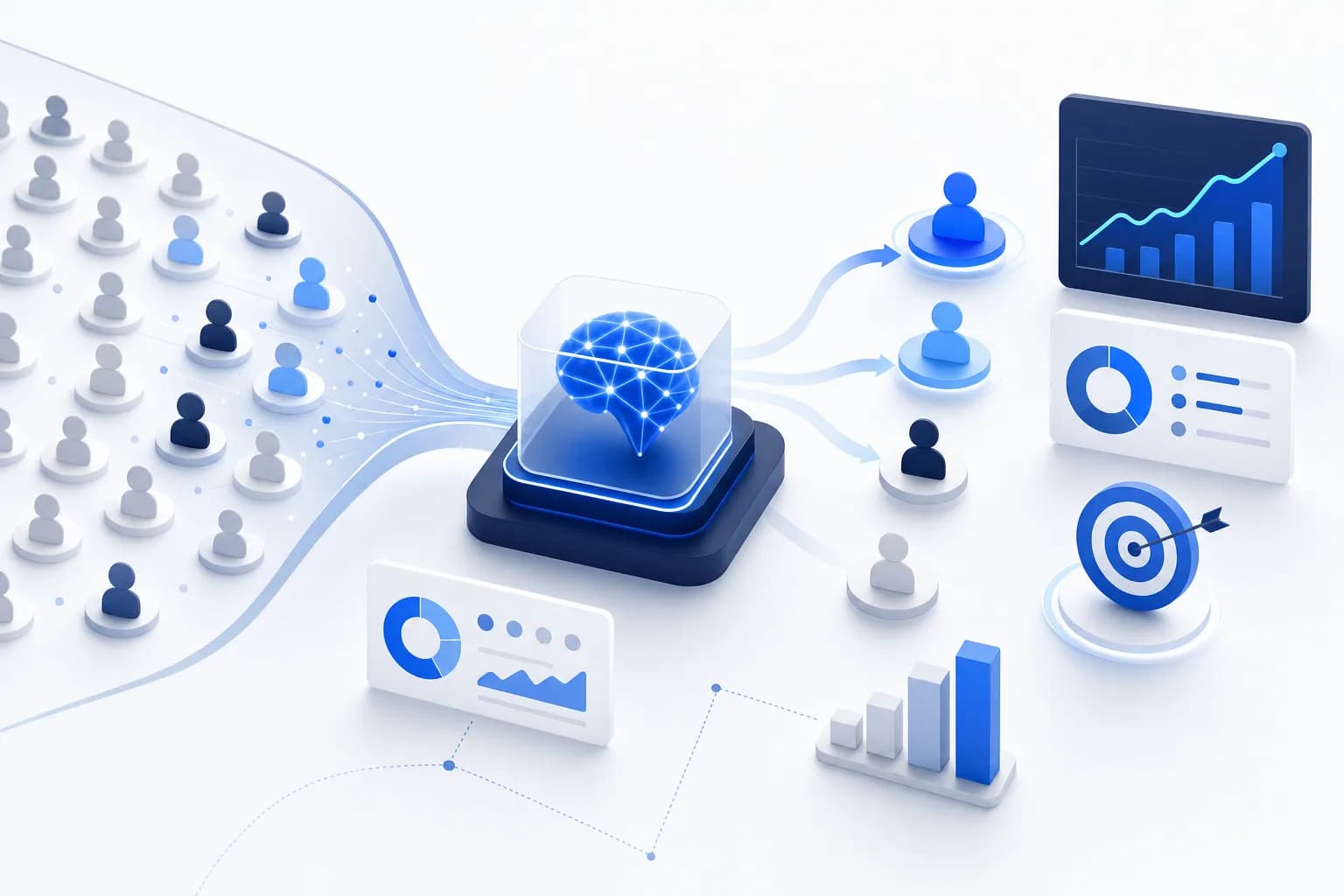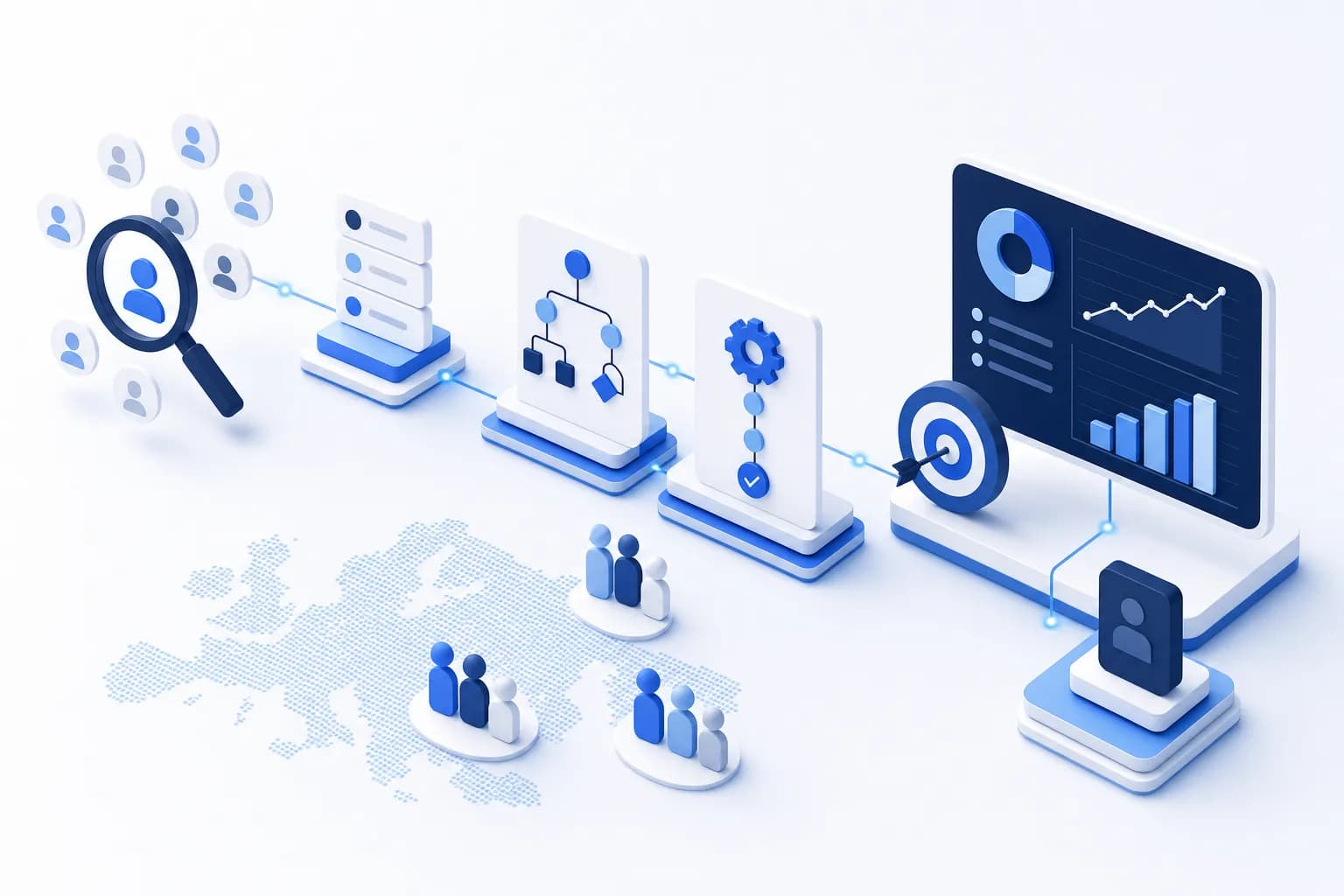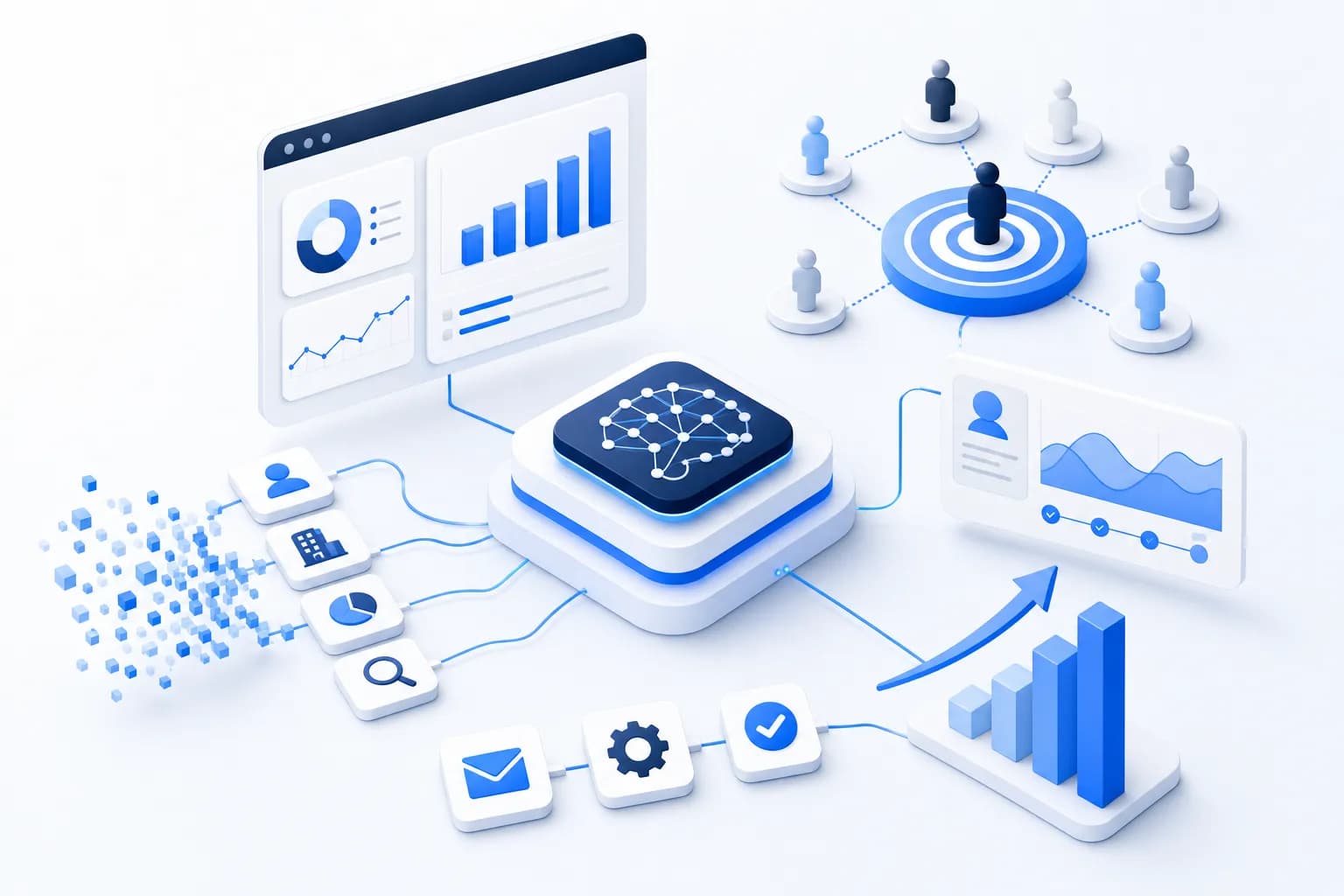
Automated new customer acquisition in B2B works as a funnel with five stages: target customer definition (ICP), lead generation, AI scoring, prioritization, and handover to sales. The first four stages can be largely automated today; from the handover onward, the human takes over — channel choice, first contact, and the conversation remain manual work, not least because email advertising requires consent under § 7 UWG (a provision of the German Act Against Unfair Competition). This article walks through the complete funnel stage by stage, names the measurable metrics for each stage, and shows how anilead.io covers the front stages.
New customer acquisition in B2B has never been as laborious — and at the same time never as automatable. Decision-makers are flooded with generic pitches and harder to reach than ever. At the same time, AI tools make it possible to find exactly the right companies, qualify them precisely, and prepare the outreach without your team spending hours on research. While our overview guide to B2B sales automation answers the question of which sales steps can be automated at all, this article looks at the process: a new customer's journey from target customer definition to handover to sales.
What is automated B2B customer acquisition?
Automated customer acquisition is a systematic process in which software continuously identifies new target companies, researches their contact data, evaluates their fit with your offering, and hands the results over to sales in prioritized form. The decisive difference from classic prospecting lies not in individual tools but in the mindset: instead of sporadic research campaigns ("we need leads again"), a permanently running pipeline emerges that delivers fresh supply every week.
The classic approach — buy a call list, dial through it, book meetings — is losing efficiency: decision-makers have less time and expect relevant outreach. What used to work through sheer volume now requires precision in the target customer profile and prioritization by fit. Exactly these two levers can be automated.
What does the automated new-customer funnel look like?
The new-customer funnel consists of five stages that build on each other: ICP definition, lead generation, scoring, prioritization, and sales handover. Each stage has a clear input, a clear output, and at least one measurable metric. If you skip a stage — for example, generating leads without having defined the target customer profile — you pay for it in the following stages with poor quality.
Stage 1: Target customer definition — the Ideal Customer Profile (ICP)
The Ideal Customer Profile is the documented description of your most profitable customer type: industry, company size, region, typical challenges, and the problem your offering solves. It is the filter through which all subsequent stages run. An example: "tax firms with 5 to 50 employees in southern Germany that do not yet use digital document processing" is a usable ICP — "companies that need software" is not. How to develop your ICP systematically is shown in our article on the Ideal Customer Profile in B2B.
This stage's metric: the hit rate of the later searches — that is, the share of found companies that your sales team rates as "fundamentally a fit". If it stays below half over time, the ICP is worded too vaguely.
Stage 2: Lead generation — finding matching companies
Based on the ICP, software automatically searches for matching companies in public data sources. For this, anilead.io translates your ICP description into concrete search queries via Claude AI and finds companies through the Google Places API; a web crawler then extracts the email addresses from the company websites. Typical searches deliver 20 to 60 leads per query — with name, address, phone, website, and email.
This stage's metrics: number of new leads per week, share of leads with a found email address, and duplicate rate. A healthy pipeline delivers a continuous supply instead of producing one giant list once a quarter.
Stage 3: Scoring — evaluating fit automatically
Not every found company is a good lead. AI-powered scoring automatically evaluates each lead against your ICP: Claude AI compares the company's industry, size, region, and web presence with your offering description and assigns a score of 0–100 with a rationale and priority. How this works technically is explained in our AI lead scoring guide.
The result: instead of 200 random contacts, you have a sorted list with comprehensible reasons why a lead fits or not. This stage's metrics: the score distribution (how many leads are above your threshold?) and the agreement between AI score and sales assessment in spot checks.
Stage 4: Prioritization — the order of processing
Prioritization means: sales does not work through the list alphabetically, but by score and priority. In practice, a simple three-way split works well: leads above a high threshold (e.g. 80) are tackled this week, the middle range goes on the follow-up list, and the rest is archived. For structured further qualification in the conversation — budget, need, timeframe, decision-maker — frameworks like BANT and MEDDIC provide the grid; our article on lead qualification with BANT and MEDDIC explains both.
This stage's metric: the processing rate — the share of top leads that were actually contacted within a defined period. A prioritized list that nobody works through is just a prettier Excel spreadsheet.
Stage 5: Handover to sales — this is where automation ends
The handover is the point at which data must become a conversation. The qualified leads move via 1-click export to HubSpot or as CSV into your CRM — with score, rationale, and all contact data. From here, a human decides on the channel and timing of the first contact. Important for Germany: under § 7 Abs. 2 UWG, marketing emails require prior express consent even in B2B — so for the first contact with researched leads, phone (with presumed consent in B2B), letter, or social networks are the appropriate channels; email follows after consent. The details are explained in our article on B2B cold email outreach in Germany, and you can find the statutory text at gesetze-im-internet.de (§ 7 UWG).
Customer acquisition does not end with the first contact: a structured follow-up process with reminders and CRM tracking decides whether a first contact turns into an order. How to organize reminders so that no lead is lost is shown in our article on follow-ups and reminders in sales.
Which metrics belong to which funnel stage?
Every funnel stage needs at least one metric, otherwise you cannot see where the process is stalling. The following overview summarizes the most important measurements:
| Funnel stage | Metric | Diagnostic question |
|---|---|---|
| 1. ICP definition | Hit rate of the searches | Do the found companies fundamentally fit us? |
| 2. Lead generation | New leads/week, email find rate, duplicate rate | Does the pipeline deliver a continuous, usable supply? |
| 3. Scoring | Score distribution, agreement AI vs. sales | Does the score separate good leads from bad ones? |
| 4. Prioritization | Processing rate of the top leads | Are the best leads contacted promptly? |
| 5. Sales handover | Reply rate, meeting rate, time to first contact | Do prioritized leads turn into a conversation? |
The rule of thumb for troubleshooting: always read from back to front. A weak meeting rate with a good processing rate points to the outreach or the target audience; a weak score distribution points to a fuzzy ICP. This turns the gut feeling of "prospecting isn't working" into a concrete adjustment lever.
Manual vs. automated: An honest comparison
What does automating stages 2 through 4 mean in working time? The following values are empirical figures for a run with 50 leads:
| Task | Manual | Automated (anilead.io) |
|---|---|---|
| Lead research (50 leads) | 8–12 hours | 15 minutes |
| Email extraction | 3–5 hours | Automatic |
| Lead qualification | 2–4 hours | Seconds (AI scoring) |
| CRM import | 1–2 hours | 1-click export |
| Total (50 leads) | ~16 hours | ~30 minutes |
At 200 leads per month, a well-configured system realistically saves 40 or more hours per month — the equivalent of an entire working week that flows into conversations and follow-ups instead. Calculating conservatively with internal costs of 60 € per sales hour, tool costs of 0 to 79 €/month (Free to Pro) are offset by savings in the four-figure range.
How does anilead.io cover the first funnel stages?
anilead.io is a B2B lead generation software for the DACH market that finds companies via Google Places, extracts email addresses, and scores every lead with Claude AI. In the funnel model, it fully covers stages 2 through 4 and supports stages 1 and 5:
- Capture the ICP (stage 1): You create a project and describe industry, region, and your offering in plain language — e.g. "SaaS providers in the DACH market, 10–100 employees, no enterprise CRM solution".
- Generate leads (stage 2): Claude AI turns this into search queries, the Google Places API delivers matching companies, and the web crawler extracts email addresses from the company websites.
- Score (stage 3): Every lead automatically receives a score of 0–100 with a rationale and priority.
- Prioritize (stage 4): The list is sorted by score; you work from top to bottom.
- Hand over (stage 5): Top leads go via 1 click to HubSpot or as CSV into your CRM; for the later outreach, the AI generates personalized email drafts that you use after the recipient's consent.
The result: your sales team starts every Monday with a fresh, qualified, and prioritized lead list — without research work. Billing works exclusively through lead credits (1 credit = 1 saved lead); all core features including scoring and export are included in every plan, including the Free plan with 50 credits per month. Data processing runs on EU servers in Frankfurt and uses exclusively public data sources.
Where automated customer acquisition hits its limits
Automation accelerates the funnel, but it replaces neither strategy nor relationships. You should plan for three limits: first, the quality of the ICP remains your bottleneck — a precise target customer description delivers sharp scores, a vague description only noise. Second, sending promotional emails to recipients without consent is not an automation question but generally impermissible under § 7 UWG; the legal responsibility for the outreach lies with you, and when in doubt the process belongs in a legal review. Third, the deal is decided in the conversation: objections, budgets, and trust cannot be delegated. Which mistakes teams make specifically when automating the outreach is shown in our article automating outbound sales; for the particularities of smaller target customers, the article on B2B leads for the Mittelstand is worth a look.
Frequently asked questions about automated customer acquisition
How quickly does an automated funnel deliver first results?
The first qualified leads are available within minutes: create a project, describe the ICP, start the search — typical searches deliver 20 to 60 leads per query including scoring. Realistically, a few weeks pass before the first meetings, because first contact and follow-up take their time. The funnel accelerates the preparatory work, not the customer's buying process.
Do I need a finished ICP before I start?
No, but a first hypothesis. In practice, an iterative approach works best: start with a rough target customer description, read the score rationales of the first searches, and sharpen the ICP based on the results. After two to three iterations, the profile is usually far more precise than any persona drafted at a whiteboard.
Can I simply email the leads I find?
Not without consent. Under § 7 Abs. 2 UWG, email advertising generally requires consent — including towards businesses. The automated funnel delivers data and outreach drafts; for the first contact, you use permissible routes like phone (with presumed consent in B2B), letter, or social networks and obtain email consent in the conversation. When in doubt, have your process legally reviewed.
What does automated customer acquisition with anilead.io cost?
Getting started is free: the Free plan includes 50 lead credits per month, 1 project, and all core features — no credit card required. Paid plans cost 29 € (Starter, 500 credits), 79 € (Pro, 2,000 credits), or 149 €/month (Agentur, 3,500 credits, team access); all cancelable monthly, with a 20% discount for annual payment. Unused credits expire at the end of the month.
Conclusion: The funnel beats the one-off campaign
Automated customer acquisition is not a tool topic but a process topic: define the ICP, generate leads continuously, score them with AI, work through them by priority, and hand them over cleanly to sales — with one metric per stage so you know where things stall. Software reliably handles the front stages; from the first contact onward, the human, the channel choice, and legal diligence are what count. Start for free with 50 lead credits per month and build your first automated funnel around a real target segment.