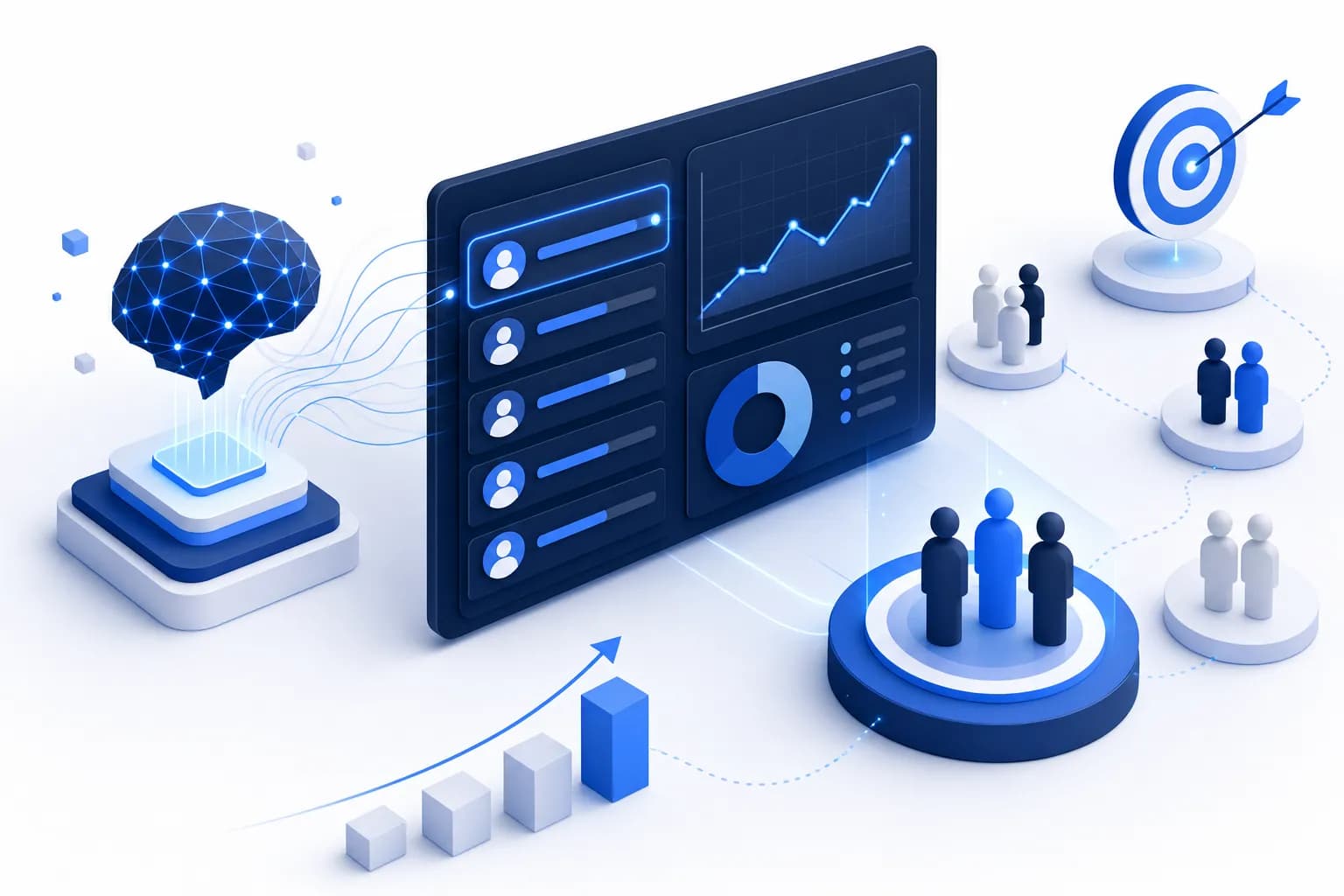
Your sales team has 500 new leads — but no clear idea whom to contact first. AI lead scoring solves exactly this problem: an AI model like Claude automatically rates every lead with a score from 0 to 100 and delivers a rationale and a priority — before your team writes the first email. That way, sales time flows into the leads with the highest closing probability instead of into a list worked through alphabetically.
The problem: All leads feel the same
Without scoring, teams usually work through the list alphabetically — or by gut feeling. The truly good leads get attention too late, while valuable sales time flows into companies that will never buy: wrong size, wrong industry, no need. The result is a sales operation that works a lot and closes little.
An illustrative back-of-the-envelope example (deliberately simplified, not a study): if a team contacts 500 unsorted leads and closes 2 percent, it wins 10 customers. If it concentrates the same energy on the 100 best-fitting leads and reaches 15 percent there — because offering and need actually match — that is 15 customers from a fifth of the contacts. Exactly this concentration on the right subset is what lead scoring delivers: it does not change your leads, it changes your order.
What is AI lead scoring?
AI lead scoring is the automatic evaluation of leads by an AI model that compares company data such as industry, company description, and size against an ideal customer profile and derives a score, a rationale, and a priority from it. For every single lead, it answers the question: how well does this company fit what you sell?
Traditional lead scoring, by contrast, works with rigid point rules:
- Industry matches? +10 points
- Right company size? +15 points
- Visited the website? +5 points
The problem: these rules are static, need manual upkeep, and capture no nuance. A tax firm with 15 employees and one with 15 employees that, according to its website, is just opening two new offices get the same points — even though the second is clearly the better lead. A language model recognizes such differences because it actually reads the company description and evaluates it in context. For a deeper look at advanced, ML-based methods, see our guide to predictive lead scoring.
How does lead scoring with an LLM like Claude work?
At anilead.io, AI lead scoring runs fully automatically as the final step of lead generation: Claude AI compares every found lead against the ideal customer profile you described and assigns a score from 0 to 100 — including rationale and priority. The complete process in five steps:
- Describe your ideal customer profile: When creating a project, you describe in plain language what you offer and whom you are looking for — product or service, target industry, region, typical company size. This description is the yardstick every lead is measured against.
- Find leads: The system searches for matching companies via the Google Places API; typical searches return 20 to 60 leads per query. It then crawls the company websites and extracts publicly available email addresses.
- Evaluation by Claude AI: Right after the search, the system processes the new leads in batches. Claude AI evaluates each lead based on industry, company description, size, and the fit with the described ideal customer profile, and assigns a score from 0 to 100.
- Rationale and priority: For every score, the model delivers a short rationale ("uses outdated industry software according to its website, is growing, matches the target size") and a priority. So you see not just a number — you can trace why a lead ranks high or low.
- A sorted list instead of raw data: Your team starts with a lead list sorted by score — and can export it as CSV or transfer it directly to HubSpot. Scoring is included in every plan, even the free one.
The decisive difference from classic systems: there are no rules to configure and no historical data to train on. The written description of your ideal customer replaces the rulebook.
What sets AI scoring apart from rule-based scoring?
Rule-based scoring, predictive scoring, and LLM-based scoring differ in data requirements, setup effort, and traceability. The table shows the three approaches side by side:
| Criterion | Rule-based | Predictive (ML) | LLM-based (e.g. Claude) |
|---|---|---|---|
| How it works | Fixed point rules (industry = +10) | Statistical model learns from historical closed deals | Language model reads company data and evaluates fit with the target profile |
| Data requirements | None, just rules | Hundreds of historical wins/losses in the CRM | Ideal customer description plus public company data |
| Setup | Manual, ongoing upkeep | Data science effort, training phase | One profile description in plain language |
| Nuance and free text | Cannot be captured | Only as pre-engineered features | Understands company descriptions directly |
| Traceability | High (rules visible) | Low (black-box model) | High (written rationale per lead) |
| Suited for | Simple cases, inbound basics | Large teams with a rich CRM history | New leads without history, SMBs, and outbound |
Predictive scoring remains the right choice if you have thousands of historical records and want to factor in behavioral signals. For freshly generated outbound leads — for which no history naturally exists yet — the LLM approach is more practical, because it works from the very first lead.
What data does AI lead scoring need?
AI lead scoring needs two ingredients: a precise description of your ideal customer and sufficient information about each lead. At anilead.io, the lead information comes exclusively from public sources — the Google Places listing and the company website; processing runs on EU servers in Frankfurt. Concretely, the evaluation takes into account:
- Industry and category: Does the line of business fit the offering?
- Company description: What does the company do according to its own profile and website — and does that match your target profile?
- Company size: Is the company in the size range your offering is built for?
- Fit with the ideal customer profile: Matching all these signals against your project description — the heart of the evaluation.
What matters is the quality of your profile description: the more concretely you describe your target industry, size range, and the problem you solve, the sharper the scores become. "Tax firms with 5 to 50 employees that still work without digital document processing" delivers better results than "companies that need software".
Real-world example: A software company looks for new customers
A B2B SaaS provider of accounting software describes its target profile and starts a search. The AI scorer rates the results like this:
- Score 94/100: Tax advisory firm, 15 employees, uses outdated legacy software according to its website, growing fast — ideal customer, high priority
- Score 67/100: Mid-sized company with a mixed software landscape — potential customer, needs more research, medium priority
- Score 23/100: Large corporation with its own IT department and existing enterprise contracts — poor odds, low priority
The per-lead rationale is what makes the difference in daily work: your team does not have to trust each number blindly, but sees at a glance why the tax firm ranks at the top — and can use that information directly in the first contact.
How do you work with scored leads in practice?
Scored leads only unfold their value through a clear working process: top leads first, react fast, personalize the outreach. A simple three-way split has proven itself — leads with a score above 80 go straight into active outreach, the middle range (roughly 50 to 79) gets further research and targeted qualification, and everything below is set aside rather than worked.
Speed pays off measurably here: a study published in the Harvard Business Review ("The Short Life of Online Sales Leads", 2011), based on an audit of 2,241 US companies, showed that firms contacting a new lead within one hour qualified it almost seven times as often as firms that reached out only after one to 24 hours. The study concerns inbound leads, but the mechanism behind it also applies to prioritized outbound lists: whoever works the best leads first and promptly loses fewer of them to the competition.
For the outreach itself: the score tells you whom to contact — the rationale delivers the substantive hook. How to turn that into individual messages is shown in our article on email personalization with AI in B2B outreach. And important for the German market: cold email outreach generally requires consent even in B2B under Section 7 UWG (the German Act Against Unfair Competition); the exception of presumed consent is to be interpreted narrowly. A high lead score is a sales priority, not a legal basis — so clarify your outreach channel and process legally in advance.
Frequently asked questions about AI lead scoring
How reliable is AI lead scoring?
AI lead scoring is a fit assessment based on publicly available company data — not an oracle for buying intent. Its strength lies in the ordering: the most promising leads sit at the top, and the accompanying rationale makes every rating verifiable. The score does not replace final qualification in a conversation; it just makes sure the right conversations happen first.
Does AI scoring at anilead.io cost extra?
No. Claude AI scoring is included in all plans, including the free Free plan with 50 lead credits per month (no credit card required). Billing runs exclusively on lead credits: 1 credit equals 1 saved lead. AI outreach emails, CSV export, and HubSpot export are also included in every plan — only credits, projects, concurrent searches, and team features are gated.
Does AI lead scoring need historical CRM data?
Not with the LLM approach. A language model like Claude evaluates the fit between lead and ideal customer profile directly, without having to learn from past deals first. Predictive scoring models, by contrast, require hundreds of historical wins and losses as training data — which is why they are rarely practical for freshly generated outbound leads or young companies without a CRM history.
From what score should you contact a lead?
There is no universally valid threshold — the distribution depends on your market and how sharp your profile is. As a starting heuristic: work scores above 80 immediately, research 50 to 79 further, and set aside anything below 50. After the first few weeks, observe at what score your reply and meeting rates drop off, and adjust the thresholds to your real results.
Conclusion: Scoring changes the order — and the order changes the outcome
AI lead scoring ensures that your sales team invests its time where the closing probability is highest — automatically, traceably, and without rule maintenance or a data science project. If you want to build a free lead pipeline in parallel, our article on generating B2B leads for free shows the right data sources.
anilead.io is a B2B lead generation software for the DACH market (Germany, Austria, Switzerland) that finds companies via Google Places, extracts email addresses, and scores every lead with Claude AI. Scoring runs automatically right after every search — every lead gets a score, rationale, and priority before your team sees it for the first time. Start for free with 50 lead credits per month, no credit card required.