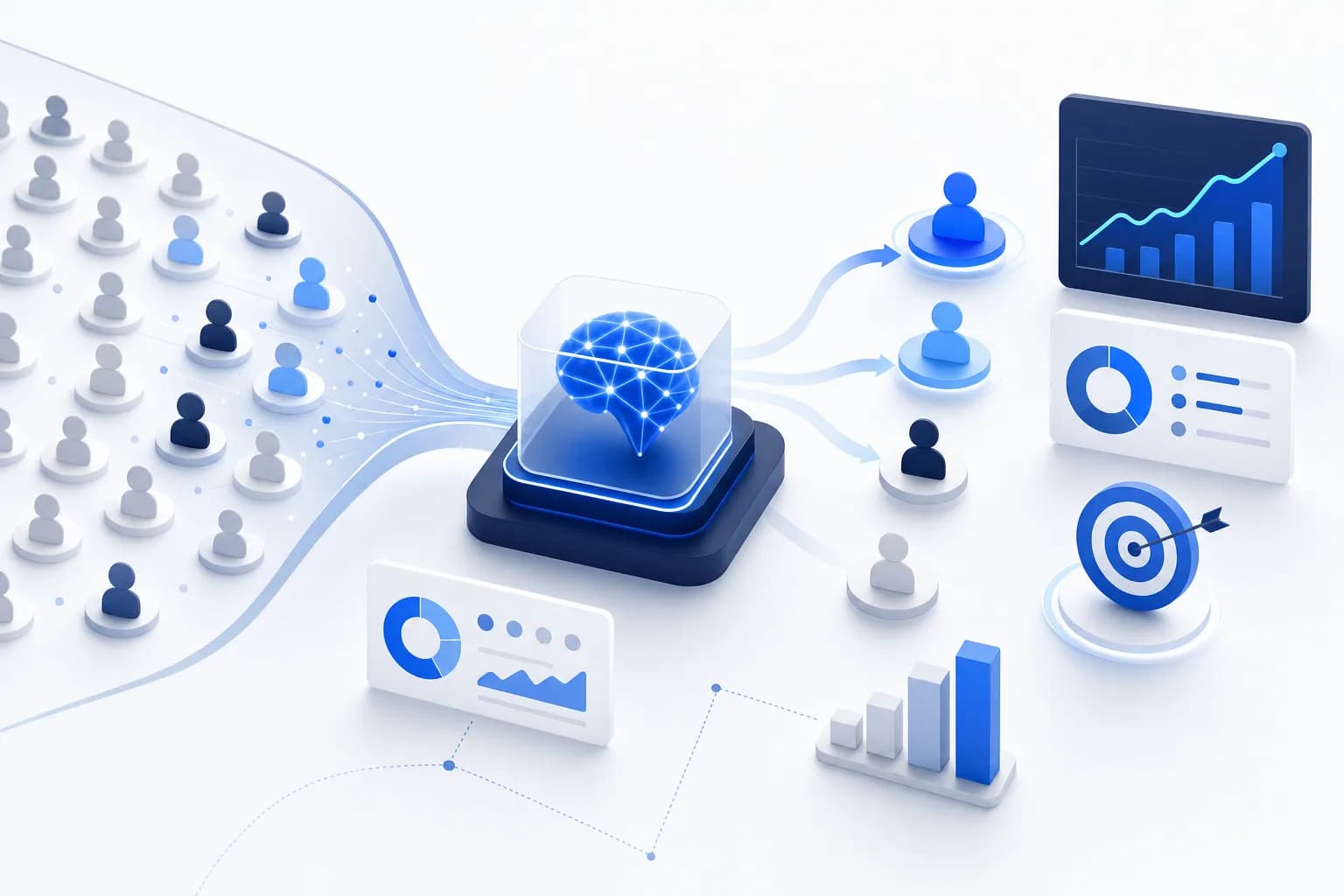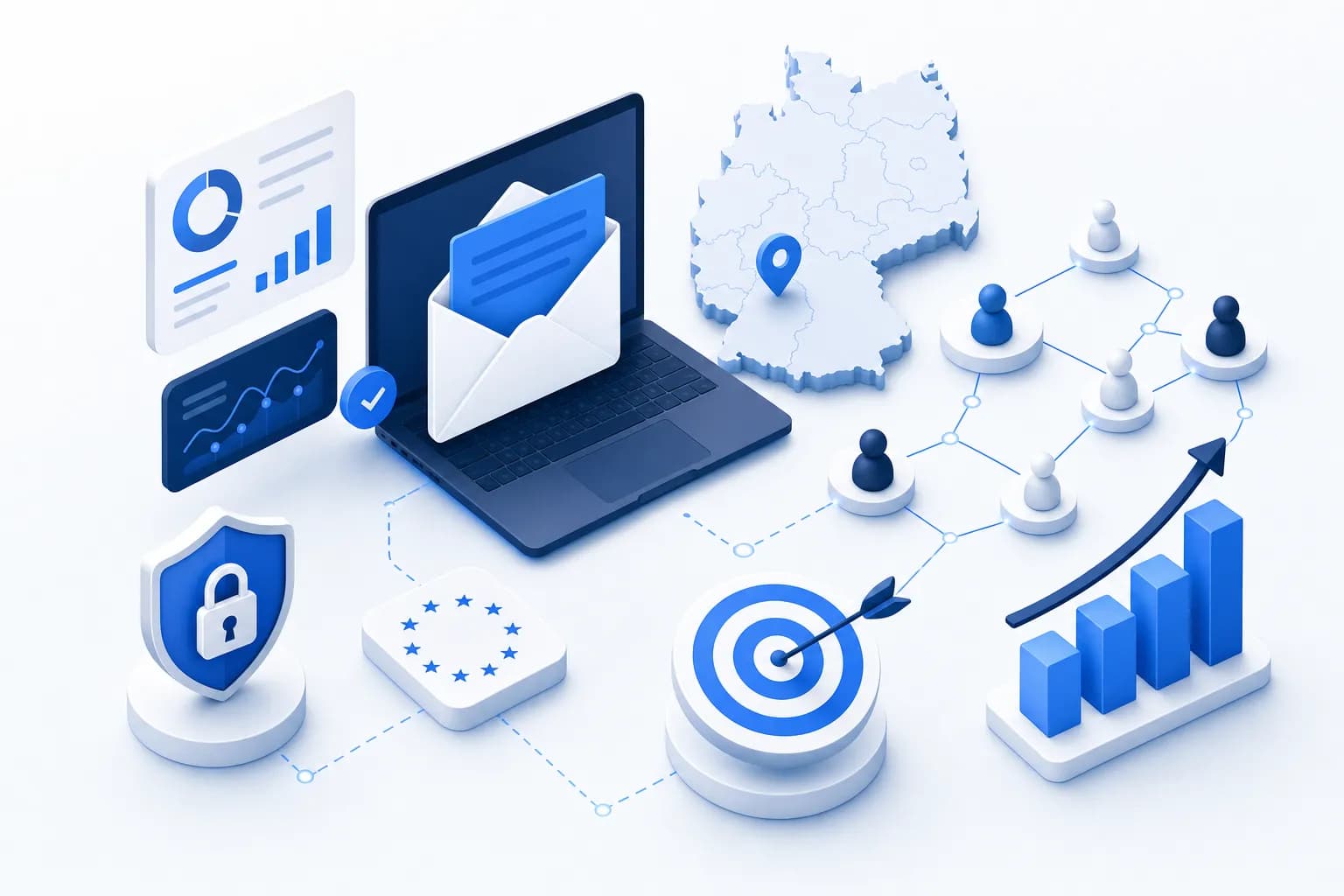
Decision-makers receive 50–100 marketing emails every day. Generic templates go straight to the trash. B2B outreach with AI solves this problem: Claude AI analyzes each lead's company website, industry, and occasion, and generates an individual email draft from that in seconds instead of a mass template. One important note up front: in Germany, marketing emails generally require the recipient's prior express consent, even in B2B (§ 7 UWG, a provision of the German Act Against Unfair Competition) — which is why anilead.io generates drafts but does not itself send any emails. The legal requirements are explained in our legal guide to email outreach.
What makes personalization in B2B outreach good?
Good personalization in B2B outreach combines three levels: the company context (what the company offers and how it positions itself), the industry (which challenges are typical there), and a concrete occasion (why you are writing right now). Just a first name in the subject line is not personalization — recipients immediately recognize that as a form letter.
Personalization in B2B outreach is the substantive adaptation of the subject line, opening, and value argument to the individual recipient — based on researchable facts about their company, not on inserted placeholders. That this expectation is real is shown by the McKinsey study "Next in Personalization" (2021): 71 percent of respondents expect personalized interactions from companies, and 76 percent react with frustration when they do not get them. The study surveyed consumers — but B2B decision-makers apply the same expectation to their inbox.
These signals make an outreach recognizably individual:
- Company context: Products, services, positioning — derived directly from the company's website
- Industry context: the industry's typical bottlenecks, phrased for this specific company instead of as a platitude
- Occasion: Expansion, a new location, a new product, open sales positions — the reason the message is relevant now
- The recipient's role: A managing director reads differently than a marketing director — tailor the value argument accordingly
- Regional proximity: an underrated door-opener, especially in the Mittelstand
As a rule of thumb: if you could replace the company name in the text with any other without a single sentence becoming wrong, the email is not personalized.
Why do generic cold outreach emails no longer work?
Generic cold outreach emails fail because they signal to the recipient in the very first line that they are one of thousands of addressees. Texts like "I would love to discuss your challenges..." or "We help companies like yours..." are interchangeable — and are treated accordingly: deleted, marked as spam, or ignored.
On top of that comes a technical effect: frequent spam flags worsen your domain's deliverability overall — they damage the sender reputation even for legitimate communication with existing customers. What works is the opposite: a few well-researched messages to cleanly qualified recipients, with a hook that recognizably fits only this one company.
The personalization paradox: Why manual research does not scale
The personalization paradox describes the trade-off in outreach: genuine personalization needs research, and research needs time — 10 to 15 minutes per lead is realistic if you seriously examine the website, industry, and occasion. At 200 leads per week, that would be 33 to 50 hours of pure research time. The result in practice: teams fall back on templates that feel like templates.
AI resolves this paradox because it automates the research step without dropping it. Claude AI analyzes the company website, classifies the industry, and writes a genuinely individual email in seconds — a dedicated draft per lead, not a template with placeholders. The human shifts their time to where it makes the difference: selecting the right recipients, polishing the text, and legally vetting the sending channel.
Is cold email outreach even allowed in Germany?
Email advertising without the recipient's prior express consent is generally impermissible in Germany — even in B2B. This is governed by § 7 Abs. 2 Nr. 2 UWG: advertising via electronic mail without the addressee's prior express consent is deemed an unreasonable nuisance. The relaxation of "presumed consent" exists only for phone calls to businesses — it does not apply to emails.
A narrowly defined exception is contained in § 7 Abs. 3 UWG for existing customers: anyone who obtained the email address in connection with a sale may, under certain conditions, advertise their own similar products — this does not apply to cold contacts. Violations can result in Abmahnungen (formal cease-and-desist warnings under German law) and injunction claims; in parallel, the data protection question of the legal basis for the processing arises. The details, permissible alternatives such as double-opt-in campaigns, phone under certain conditions, letters, or LinkedIn, as well as typical mistakes, are summarized in our guide to B2B cold email outreach in Germany.
For your AI outreach, this means: AI-personalized email drafts combine company context, industry, and occasion into an individual first approach — but sending them to B2B recipients in Germany generally requires prior consent under § 7 UWG. That is why anilead.io exclusively generates drafts and does not itself send any emails: through which channel and on which legal basis you use the text — for example after obtaining consent, as a call script on the phone, as a LinkedIn message, or as a letter — is your decision and your responsibility. When in doubt, clarify your outreach process with legal counsel; this article is not legal advice.
How is a good first approach structured?
A good first approach consists of four building blocks: a concrete subject line, a personalized opener, a specific value proposition, and a low-threshold call to action — five to seven sentences at most in total. Each building block has exactly one job, and every common mistake can be attributed to one of them:
| Building block | Job | Common mistake |
|---|---|---|
| Subject line | Trigger the open: concrete, recipient-focused, without marketing speak (e.g. "Question about your sales automation") | Clickbait, ALL CAPS, generic promises like "More revenue" |
| Opener | Show in one sentence that you truly know the company — an occasion or observation instead of a platitude | "I hope this finds you well" or a self-introduction in line one |
| Value | One clear, specific benefit, phrased as an outcome for the recipient | Feature bingo: three products, five functions, no discernible relevance |
| Call to action | One concrete, low-threshold action — such as a 15-minute call with a proposed time | Vague closings ("Feel free to reach out") or several CTAs at once |
The opener is the sentence where personalization becomes visible — it decides whether the rest gets read at all. The order is deliberate: first the recipient and their context, then your offering, and finally the call to action.
Example: AI-personalized vs. generic
The difference becomes tangible in a direct comparison. Both of the following texts are fictional illustrative examples — they show the structure, not real campaigns or customers.
Generic (gets ignored)
Subject: More revenue for your company
Dear Sir or Madam,
I am writing to you today to introduce our innovative CRM system, which has already helped many companies optimize their sales...
AI-personalized (gets read)
Subject: Question about your expansion into Austria
Hello Mr. Mueller,
I see that Mueller GmbH is currently planning its market entry into Austria (congratulations!). Growth phases often mean: more leads, but also more manual work in sales.
We help B2B teams fill new markets with qualified leads automatically — without manual research effort. Would a 15-minute call be possible this week?
Best regards,
Max
The second text follows the four building blocks exactly: the subject line names a company-specific occasion, the opener proves research in one sentence, the value connects the occasion to an outcome, and the CTA is a single small action. This is precisely the structure Claude AI generates anew for each lead — with that lead's real context.
How does Claude AI in anilead.io generate individual email drafts?
anilead.io is a B2B lead generation software for the DACH market that finds companies via Google Places, extracts email addresses, and scores every lead with Claude AI. The outreach generation builds on this data basis: for each individual lead, Claude analyzes four dimensions and writes a dedicated draft from them.
- Company website: the lead's products, services, and positioning — the foundation for an opener with a genuine company reference
- Industry context: the industry's typical challenges, translated into the situation of this specific company
- Connection points: where your offering (from your project description) concretely connects to the lead's needs
- Tone and language: a classic DACH Mittelstand company is addressed differently than a tech startup
Scoring and personalization interlock here: the lead score from 0 to 100 tells you whom to prioritize — and the accompanying rationale often already provides the substantive hook for the opener. How the scoring works in detail is shown in our article AI lead scoring: how it works; the strategic framework is provided by the guide to predictive lead scoring with AI.
The result is an individual outreach text in German or English that you can copy, adapt, and use in your process. The feature is included in every plan, including the Free plan — deliberately, nothing is sent from within anilead.io. What to observe legally when using it is summarized in the legal guide linked above.
How do you test AI outreach systematically? The A/B mindset
A/B testing in outreach is the structured comparison of two variants under otherwise identical conditions: the same target audience, the same period, only one changed element. Instead of debating whether AI texts are "better", you measure it — on your own recipients, not against third-party benchmarks.
For context: many sales teams share the experience that individually researched emails are opened and answered considerably more often than mass templates — sometimes several times as often. However, robust, independent studies with clean methodology are rare; published benchmarks mostly come from tool vendors with a vested interest. That is exactly why the A/B mindset matters so much: your own numbers are the only statistics that truly apply to your market.
Here is how to proceed:
- One variable per test: Compare the AI draft against your best manual template — but do not change the subject line, send time, and target audience at the same time
- A sufficient sample: With 20 recipients per variant, any result is chance; plan for recipient counts in the hundreds per variant before drawing conclusions
- The right metric: Open rate only measures the subject line. More meaningful are the reply rate, the positive reply rate, and booked meetings
- Iterate instead of discarding: If a variant loses, analyze the building block (subject? opener? CTA?) and keep testing in a targeted way
Best practices for AI outreach
AI outreach works best as an interplay: the AI delivers research and the raw draft, the human delivers judgment, voice, and the legal framework. These rules have proven effective:
- Always proofread: AI occasionally makes mistakes with names, numbers, or facts — a wrong company name destroys exactly the credibility personalization is meant to build
- Bring in your own style: The AI text is a raw draft, not a finished product; two or three phrasings in your own tone make the difference
- Clarify the legal basis before sending: The best text changes nothing about § 7 UWG — check consent and channel before you send
- Sequence instead of a single email: Personalize follow-up messages too — anyone who sends a generic follow-up after an individual first approach devalues both
- Quality over volume: Better 30 well-qualified, individually addressed leads per week than 300 recipients of a mass mailing
Conclusion: Personalization now scales — the responsibility stays with you
AI personalization is not a gimmick but the path to outreach texts that still get read in a full inbox: company context, industry, and occasion in every single draft, without hours of manual research. With anilead.io you get both from one tool — qualified, scored leads and the matching draft for the first approach, included in every plan. What the tool deliberately does not take off your hands: cold email outreach in Germany remains subject to consent as a rule — the draft is your tool, its legally sound use is your job. The fastest way is to try it yourself: create a free account with 50 lead credits per month and have drafts generated for your first leads.
Frequently asked questions about AI-personalized outreach emails
May I simply send AI-generated emails to cold B2B contacts?
No. Under § 7 Abs. 2 Nr. 2 UWG, marketing emails in Germany generally require prior express consent — including towards businesses. AI generation changes nothing about that: it delivers the text, not the legal basis. Use drafts after obtaining consent or via other channels, and when in doubt, have your process legally clarified.
Does AI personalization completely replace your own research?
No, it replaces the time-consuming part of it. Claude AI handles the website analysis, industry classification, and raw draft — saving many minutes per lead. The final check stays with the human: verifying facts, adding your own tone, and deciding whether the hook really holds. As a rule of thumb: AI delivers 80 percent, and your final 20 percent make the message credible.
In which languages does anilead.io generate outreach drafts?
anilead.io generates outreach drafts in German or English. The tone adapts to the context: a classic DACH Mittelstand company receives a more formal approach than a startup. You can freely edit every draft before using it — it is meant as a starting point, not an immutable end product.
What does the AI outreach feature cost?
Nothing extra: AI-personalized outreach emails, like Claude AI lead scoring, CSV export, and HubSpot export, are among the core features included in every anilead.io plan — including the Free plan at 0 euros with 50 lead credits per month, no credit card required. Paid plans from 29 euros per month increase credits, projects, and concurrent searches, not the feature set.
Which metric best shows whether personalization is working?
The positive reply rate — that is, the share of recipients who respond with interest — and the meetings booked from it. Open rates only measure the subject line and are increasingly unreliable technically. Always compare variants in an A/B test with one variable and a sufficiently large sample, instead of relying on third-party benchmarks.