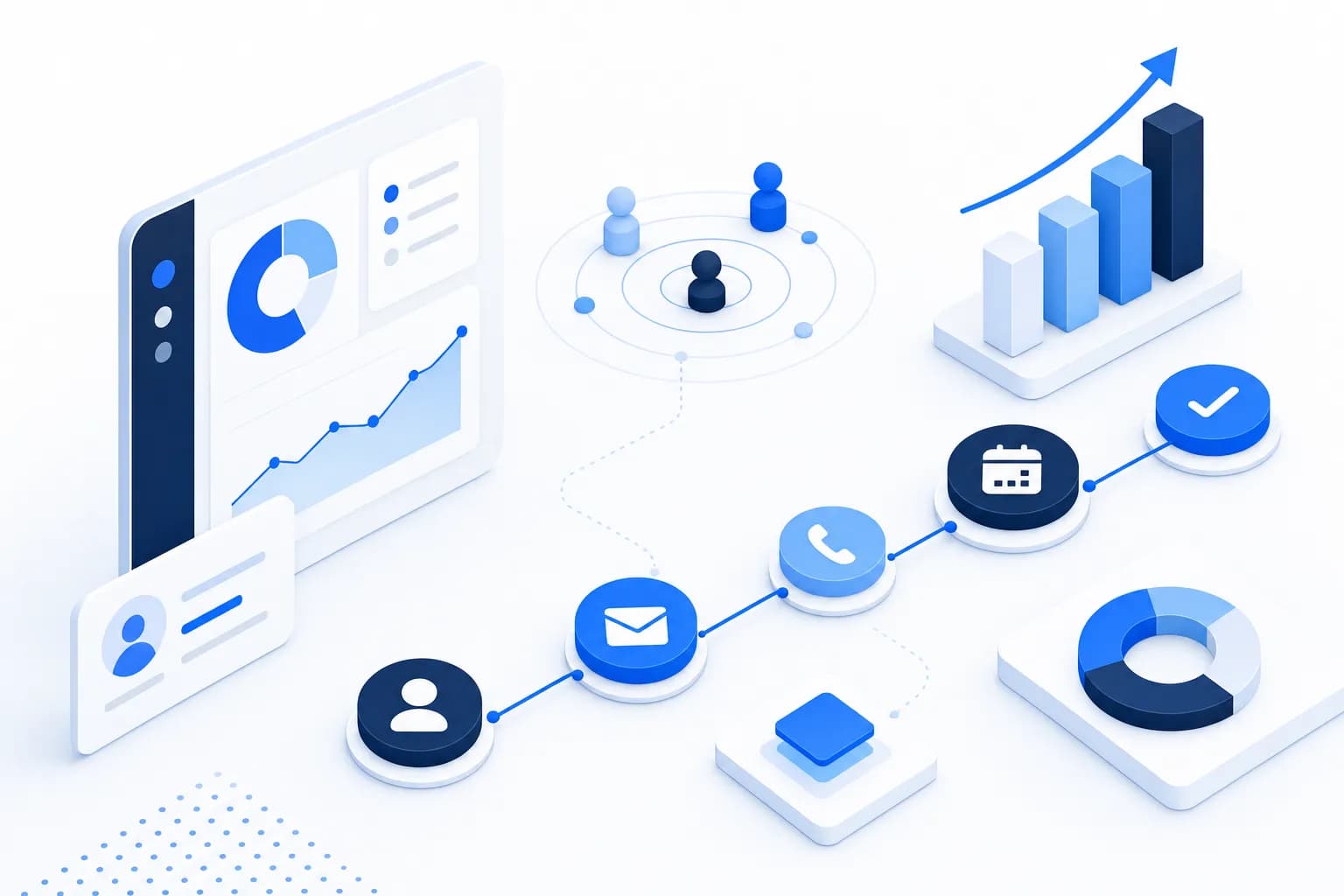
The most valuable lead is worthless if no one follows up consistently. In B2B sales it is not the first contact that decides the close, but the persistence afterwards. Studies have shown the same pattern for years: the majority of closings only happen after the fifth contact attempt, while the majority of sales teams give up after the second. It is precisely in this gap that the biggest, often overlooked revenue lever lies. This guide shows how to stop losing leads with a systematic recall strategy.
Why most deals need five or more touches
A B2B purchase is rarely a spontaneous decision. Between the first call and the signature lie budget approvals, internal alignment, vacation periods, and simply the day-to-day business that your contact currently considers more important than your offer. Not getting a no almost never means a yes, but usually a "not now".
The numbers are clear: around 80 percent of sales require five or more follow-up actions after the first contact. At the same time, nearly half of salespeople give up after a single attempt, and only a small fraction reach five contacts at all. Anyone who stays on it with discipline ends up barely competing with other providers, because most have long since given up.
The brutal truth: it is not the better product that wins, but the team that actually makes the fifth, sixth, and seventh contact instead of forgetting it.
What makes a good cadence
A sales cadence is a planned sequence of touchpoints across defined channels and time intervals. A good cadence meets four conditions:
- Multichannel. It combines calls, emails, and where appropriate further channels, because different people are reachable in different ways.
- Staggered in time. The intervals start close together and grow larger with each step, to stay present without becoming intrusive.
- Value-oriented. Each contact provides a reason, such as a case study, a relevant impulse, or a new perspective, instead of merely "just checking in again".
- Finite. It has a defined end, so that leads do not hang in limbo forever, but are cleanly qualified or let go.
The combination of channels is decisive here. A call creates closeness and immediate feedback, an email delivers arguments that can be reread and that the recipient can process at leisure. Anyone who cleverly interlocks the two doubles their reachability. How to make the written side highly effective is shown in our article on email personalization with AI.
Example cadence for 21 days
The following cadence is suited to a warm B2B lead after initial interest. Adapt the intervals and channels to your sales cycle, but maintain the systematic approach.
| Day | Channel | Goal | Content |
|---|---|---|---|
| Day 1 | Call | First contact | Clarify the need, spark interest |
| Day 1 | Follow-up | Conversation summary, materials | |
| Day 3 | Call | Recall | Follow-up questions, open points |
| Day 5 | Added value | Fitting case study or reference | |
| Day 8 | Call | Recall | Offer a concrete proposal |
| Day 12 | Impulse | Relevant industry trigger | |
| Day 16 | Call | Recall | Prompt a decision |
| Day 21 | Closing loop | Friendly break-up email |
Eight planned contacts over three weeks, four of them calls. This means you clearly exceed the critical threshold of five contacts and are far ahead of the competition, which usually falls silent after contact two.
Timing: when you should follow up
Experience shows the best time for a call is in the late morning and early evening, when decision-makers are reachable between meetings. In addition, react as quickly as possible to fresh signals: a lead who has just visited a pricing page or replied to an email should receive contact within minutes to hours. The probability of closing drops with every hour that passes.
For colder contacts the opposite applies: here patience over weeks pays off. The mistake is not contacting too often, but doing it uncoordinated and without memory. How initial outreach and timing differ for cold leads is examined in our article on ICP definition, because anyone who approaches the right companies needs to follow up less often.
No lead gets lost: systematic recall
The most common reason for lost deals is mundane: the callback on day 8 was simply forgotten. As soon as a salesperson manages more than a handful of active leads, manual memory becomes unreliable. Notes, calendar entries, and mental reminders do not scale.
The solution is an automatic recall. After each contact, the system sets the next contact time and reports back punctually. That is exactly what the anilead.io dialer does: if a call ends with "try again later" or "call back in two weeks", the tool automatically sets a recall and places the lead back on top of the stack on the right day. Your team then simply works through a cleanly prioritized call list, instead of wondering who they should actually be contacting today.
This systematic approach can be automated further, for example through defined triggers and handoffs to the CRM. Our guide to sales automation gives a comprehensive overview of the possibilities.
Common mistakes when following up
- Giving up too early. After two attempts, the deal is statistically far from lost.
- Only one channel. Anyone who only emails or only calls loses half of their contacts.
- No added value. "I just wanted to check in" is the weakest subject line in the history of sales.
- No documentation. Without a recorded history you repeat yourself or lose the thread.
- No end. Leads without a defined ending point tie up capacity that would generate more revenue elsewhere.
The break-up email as an underestimated weapon
The last step of every cadence is often the most effective. A polite break-up email signals that you are closing the contact for now, and surprisingly often triggers a reaction. The reason lies in psychology: the removal of an option creates more pressure to act than any further inquiry. Phrase it briefly and without reproach, for example: "I have reached out several times and assume this topic is currently not a priority. I am closing the matter, but am happy to get back in touch as soon as it fits better." Not seldom, this is exactly what prompts the reply you waited three weeks for.
It is also important how you cleanly park a "not yet" lead. Instead of losing it, set a long-term recall, for example in three or six months, with a note on the context. This keeps the lead in the system without tying up capacity in day-to-day business, and it resurfaces exactly when the time is right. This separation between active cadence and long-term recall is the key to a pipeline that does not overflow and yet forgets nothing.
Conclusion
Systematic follow-up is not busywork, but the most profitable discipline in sales. Anyone who defines a clear cadence, combines channels, and reliably keeps every recall wins deals that others long ago wrote off. The difference between a good and an average team rarely lies in the pitch, but in the fifth, sixth, and seventh contact that actually takes place.
With anilead.io the dialer automatically sets the appropriate recall after every call, prioritizes your call list, and syncs everything to HubSpot, so that no lead falls through the cracks anymore and your team consistently stays on it.